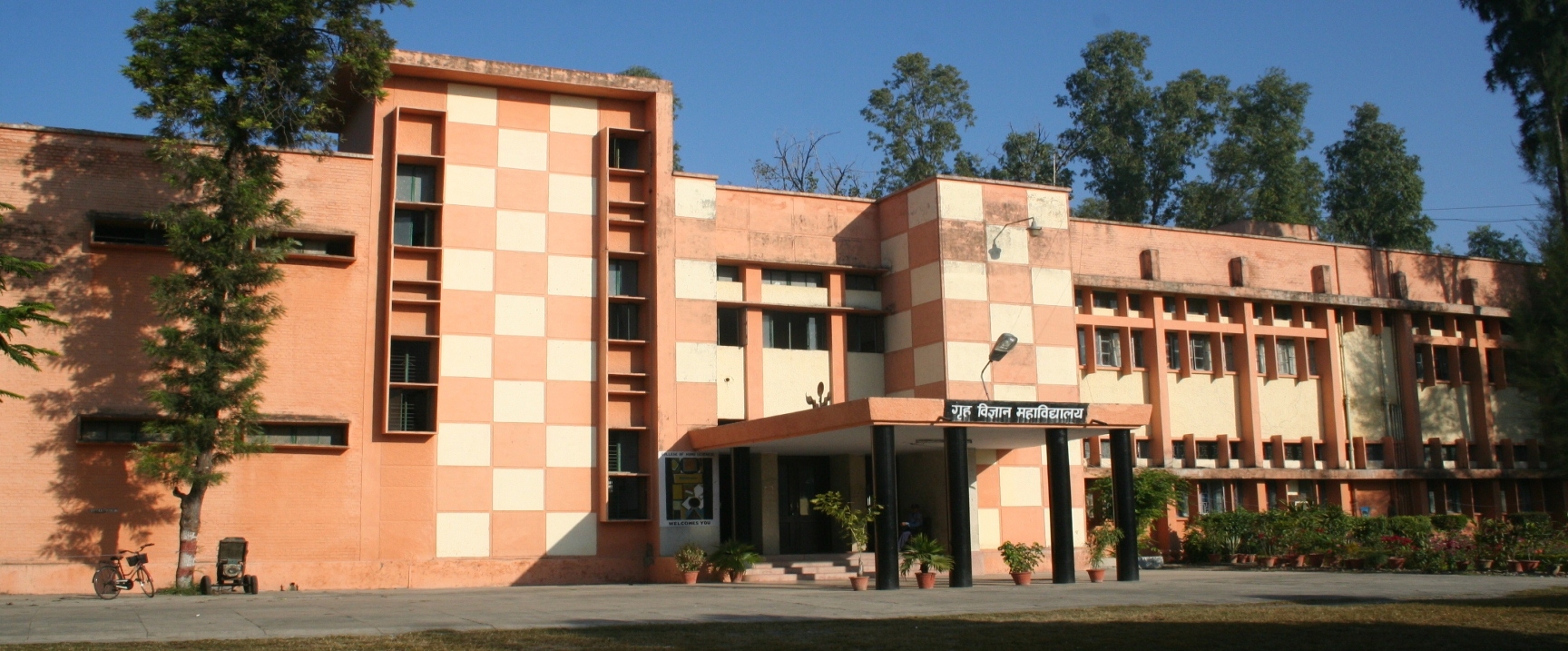
The initiation of the Home Science Programme at Pantnagar was recommended by Mrs. Alice M. Fisher (USAID) and Dr. Elda Robb (University of Tennessee, USA) in 1961. Thereafter, the U. P. Govt. gave the green signal in December 1963. Dr. Janice Smith (UIUC, USA) recommended a two-year Diploma and four-year undergraduate degree programme in Home Science in February 1966. The College of Home Science was thus established on 15 July 1971 with an undergraduate programme. From 1971 to 1985, a single programme of two-year diploma and four-year degree continued.
In 1985 it was discontinued and a diploma and three-year degree was started, for which the requirement was inter-science. Then in 1998, a four-year degree programme was started which was open to both intermediate science and intermediate arts with Home Science as one of the subjects. It included vocational courses involving Rural Awareness Work Experience and in-plant training.
In 2004, the four-year undergraduate degree programme was revised to include a 2+2 system with two years of professional training in different disciplines of Home Science — Apparel Designing, Interior Designing and Decoration, Nutrition and Dietetics, and Organization and Management of Early Childhood Programmes — which also included Rural Awareness Work Experience and In-plant Training. In 2017, B.Sc. (Hons) Community Science was started with three years of common course work and one year of specialization.
Vision of the College
To motivate primary stakeholders for sustainable development of human resources with a strong emphasis on excellence in academics, research and extension to realize direct benefits of the growing domestic and global employment market, and to ensure adequate availability of competent professionals and paraprofessionals to occupy a relevant niche in the economy by enabling an interactive coupling between industry, government, economy, environment and society.
Mission of the College
To fulfil the vision through development of need-based curriculum that would enable the graduates and paraprofessionals of Home Science to become active partners in the economic growth and development of the community — be it the family, local society, nation or world.
Mandate
- To impart knowledge and skills to graduates of Home Science to realize direct benefits of the employment market.
- To plan and execute need-based, multi-disciplinary and action-oriented research projects for improving the quality of life of the people, especially of Uttarakhand.
- To promote economic and technological empowerment of women and youth in home, farm and allied activities.
- To inculcate entrepreneurial skills and organize training/courses for the community to facilitate entrepreneurship.
- To develop interactive linkages with industries, government as well as non-government organizations.
Uniqueness of our Education Programme
The education system of the College includes an Advisory System; a multidisciplinary approach (courses of Basic Sciences, Agriculture and Veterinary Science along with Home Science courses); practical training in life-supporting skills — Rural Awareness Work Experience and In-plant training; an “Earn While You Learn” scheme for the benefit of poor students; an internal-external examination system; well-established infrastructure facilities; and scholarships to meritorious students.
Thus, our education system facilitates self-actualization by channelizing and maximizing students’ potential; builds change agents for equity, social justice and dignity; explores under- and un-utilized resources for sustainable development; links with government, NGOs and industries; builds capacity for self-employment, entrepreneurship and community development; enhances women empowerment; and develops competencies among students to serve as professionals taking up Corporate Social Responsibility activities with the corporate world, providing unique in-depth rural exposure combined with an urban base for students’ skill development through its successful field outreach programme.